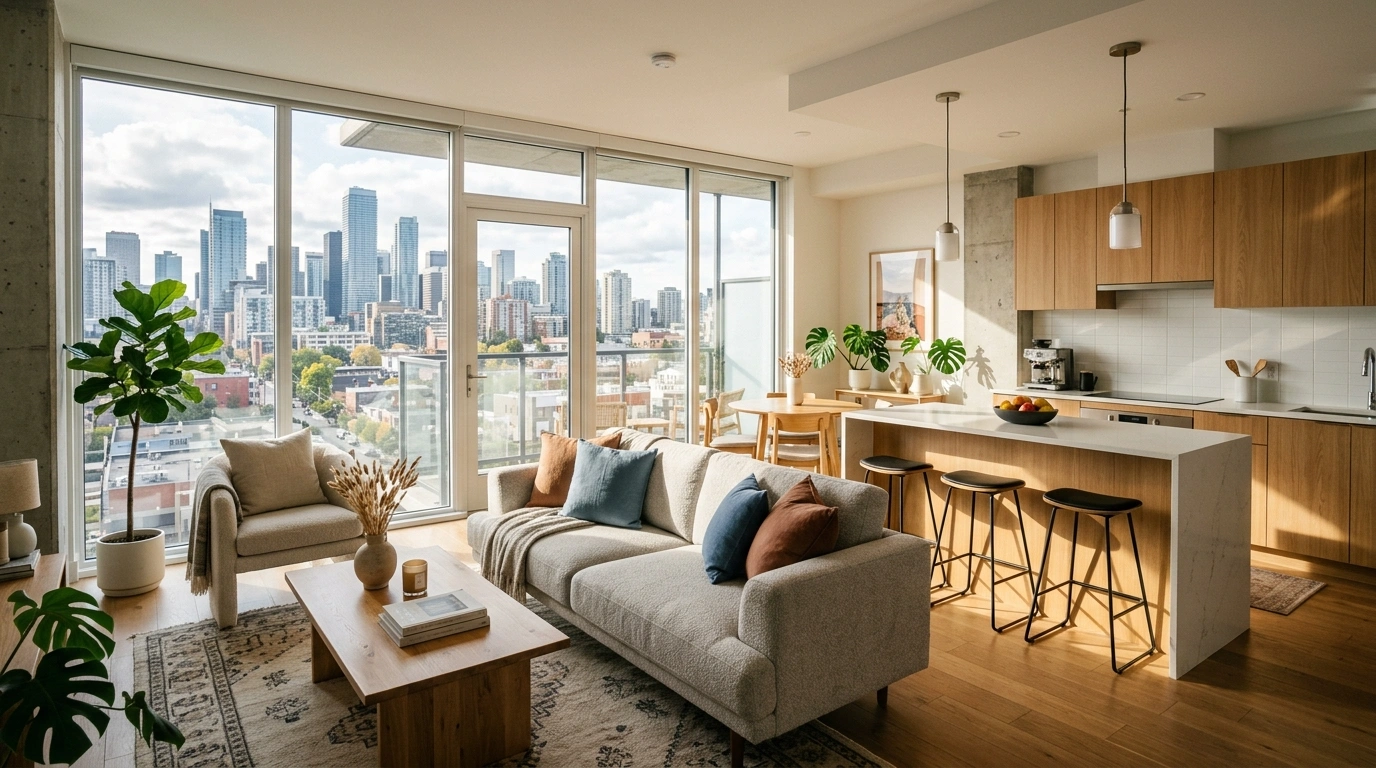
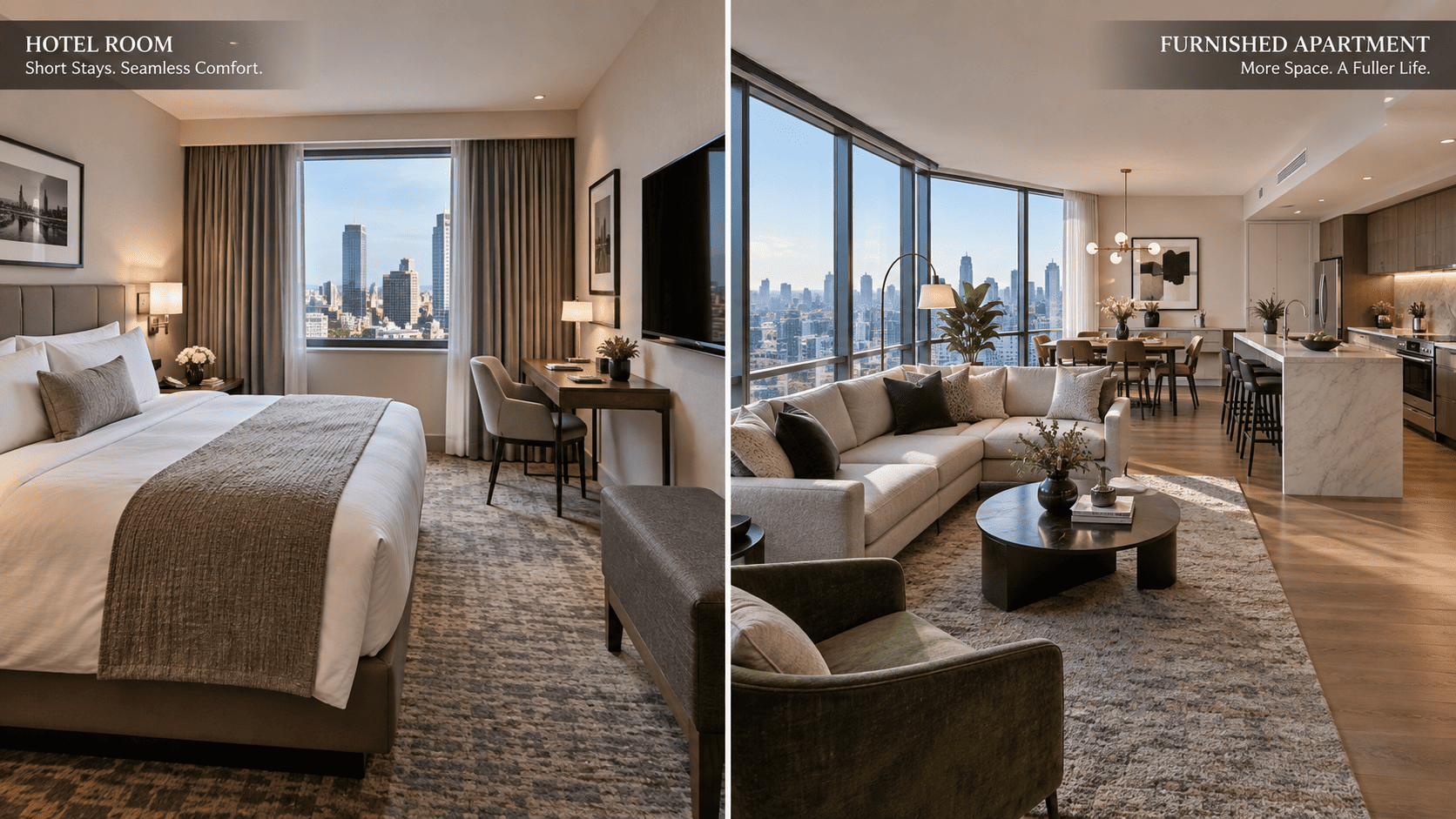
For a trip of a few nights, a hotel wins on simplicity. For anything longer, a furnished apartment almost always delivers better comfort, more space, and lower all-in cost. That gap only widens the longer the stay runs.
According to Lighthouse's short-term rental market report, 2025, 45% of travelers now compare short-term rental options and hotels before committing to a booking, a sign that the line between the two has blurred enough that neither is an automatic default. That said, the hotel vs apartment choice is rarely that clean-cut. It depends on what the stay is actually for: a weekend conference, a two-week work assignment, a family relocation, or a medical visit.
This guide covers exactly that: comparing hotel vs apartment across space, cost, privacy, and daily convenience, with a clear breakdown of when each option wins.
What Is the Difference Between a Hotel and an Apartment?
A hotel is a managed hospitality property where guests pay for a room plus a set of included services: daily housekeeping, front desk coverage, and a predictable guest experience. A short-term apartment, whether furnished, serviced, or both, is a self-contained residential space with separate rooms, a real kitchen, and a layout designed for living rather than lodging.
The simplest way to frame the difference between a hotel and an apartment: hotels are built around service; apartments are built around space. Both matter. The question is which one matters more for a given stay.
How Do Hotels and Apartments Compare for Short-Term Stays?
The hotel vs apartment comparison shifts depending on which factor gets weighed. Here is how the two options stack up across the dimensions that matter most for short-term guests.

Space and Usable Layout
A hotel room puts sleeping, working, and relaxing in the same square footage. Even generous rooms top out at a desk, a bed, and a small seating area. Apartments separate those functions into distinct zones that serve different purposes at different times of day.
A typical furnished apartment provides what a hotel room cannot match:
- A separate bedroom that stays dark and quiet while the rest of the space stays active
- A living room for decompressing, taking calls, or hosting a colleague
- A dining area that doubles as a proper workspace
- A kitchen that removes the need to leave the building for every meal
This difference is nearly invisible on a one-night visit. By night five, it becomes the dominant factor in how comfortable and functional the stay feels. Guests who spend a full week in a hotel room often describe a creeping sense of confinement that has nothing to do with the room's actual size.

Cost Structure and Hidden Fees
Hotels charge a nightly rate that rarely reflects the true total. Parking, resort fees, breakfast, laundry, and room service accumulate quickly, sometimes adding 30-50% on top of the headline price. Apartment rates for extended stays are typically flat and inclusive, often bundling utilities, internet, and cable into a single figure.
The kitchen factor closes much of any remaining rate gap. Guests in apartment-style accommodations can save more simply by cooking their own meals rather than relying on hotel dining or room service. Over two weeks, that figure more than offsets a higher nightly apartment rate in most major markets.

Privacy and Daily Routine
Daily housekeeping means daily room access. For a one-night stay, that is simply how hotels work. For a guest on a two-week assignment trying to keep a consistent routine, scheduled interruptions at unpredictable hours are a different matter.
Apartments give guests full control over their own space and schedule. No mandatory checkout window, no knock at 9 a.m., no need to clear the bathroom counter before noon. That autonomy matters most for guests managing health conditions, family routines, or intensive work schedules during a stay.
Services and the Serviced Apartment Middle Ground
Here is where the serviced apartment vs hotel question becomes most useful. A standard hotel offers daily housekeeping, concierge support, and a permanently staffed front desk. A basic furnished rental offers none of those. A serviced apartment sits in between: residential space and self-sufficiency, paired with professional guest support and scheduled cleaning.
Comparing a serviced apartment vs. a hotel for a 10-day business trip, the serviced apartment wins on livability while the hotel wins on hands-off convenience. For guests who want the home-like feel of an apartment without giving up reliable assistance, the serviced apartment is the practical answer.
Properties like those at Global Luxury Suites pair quality residential space with 24/7 expert support, which removes the main practical objection to choosing an apartment over a hotel.

Kitchen Access and Self-Catering
A hotel minibar and a lobby restaurant are convenient for one night and expensive for ten. Guests with dietary restrictions, families with young children, or anyone who prefers eating on their own schedule will feel the constraint early.
A fully appointed kitchen, with real appliances, cookware, dishes, and counter space, changes the economics and flexibility of any extended stay. Guests can cook before an early meeting, store groceries for the week, and eat dinner when it suits them rather than when a restaurant opens. This practical freedom is one of the primary reasons guests return to apartment-style accommodation for repeat corporate and relocation trips.
Suitability by Stay Length
Hotels are designed for transient visits: one night, two nights, a long weekend. The model works well when guests are mostly out and just need somewhere to sleep and shower. Apartments become more practical and more cost-effective as the stay extends beyond a few days.
According to Hotel News Resource, 2026, the average length of stay has increased across multiple markets compared to pre-pandemic levels, with extended-stay formats now delivering more stable occupancy than traditional hotel rooms. Major hotel groups are responding by launching apartment-style products of their own, a telling signal about where guest preferences have moved.
Which Option Delivers Better Value at Each Stay Length?
Value is not only a price question. The right accommodation depends on what the guest needs to function comfortably day to day.
| Stay Length | Stronger Option | Key Reason |
| 1-3 nights | Hotel | Simple, fully serviced, no setup required |
| 4-14 nights | Apartment (most cases) | Kitchen, laundry, and space advantages compound |
| 2+ weeks | Apartment | Flat rate, cooking savings, and in-unit laundry essential |
| Corporate relocation | Serviced apartment | Residential setup, utilities included, guest support |
| Family travel | Apartment | Separate sleeping areas, kitchen, laundry, non-negotiable |
Beyond the nightly rate, the value factors that favor apartments for extended visits include:
- In-unit laundry: eliminates laundromat trips and saves meaningful time on longer assignments
- Separate work and rest zones: critical for remote workers and business travelers who need to keep work and downtime physically separate
- Utilities and high-speed internet included: removes the unpredictable cost additions common in hotels
- Starter kit on arrival: quality furnished apartments provide coffee, household basics, and toiletries so guests can settle in without an immediate errand run on day one
The generational shift reinforces this trend toward apartment-style stays. A 2025 joint Situ and YouGov study reported by The Business Travel Magazine found that Gen Z business travelers are actively gravitating toward non-hotel accommodation, including serviced apartments and short-term rentals, at a rate higher than any previous generation. Living in a hotel vs. an apartment for extended work trips is increasingly a settled question for younger professionals: they choose the apartment.
For travelers comparing short-term furnished apartment options in major U.S. cities, the per-night value increases substantially once cooking, laundry, and utility savings are accounted for alongside the quality of the living space.

What Are the Honest Limitations of Each Option?
Neither choice is ideal in every situation. Recognizing the specific trade-offs, written in terms of what guests actually experience rather than generic disclaimers, helps avoid the wrong booking.
For hotels, the real risks for stays beyond a few nights:
- Room size becomes a quality-of-life issue by day four or five, not just a comfort footnote
- Add-on costs are difficult to predict before arrival and hard to avoid once checked in
- Working from a hotel desk for consecutive days is more mentally fatiguing than most guests expect
- Dining costs accelerate sharply in urban hotel locations, where on-site restaurants serve captive guests at premium prices
For apartments, what guests should verify before booking:
- Housekeeping frequency varies; some properties include weekly cleaning, others charge extra for it
- Starter kits cover the first few days only; guests on longer stays are responsible for restocking essentials
- In-unit laundry is standard at premium furnished apartments but not guaranteed at every listing, so worth confirming upfront
- Utility inclusions should be verified in writing, particularly electricity caps, which matter for guests working from home all day
For anyone weighing living in a hotel vs apartment over two weeks or more, the cost and comfort gap in favor of the apartment widens with each passing day. The hotel that feels adequate on day two is a different experience by day fourteen, and the hotel vs apartment comparison stops being close at all.
How to Choose: Hotel vs Apartment Based on Your Actual Trip
The clearest way to settle the hotel vs apartment question before booking is to count the nights honestly and then calculate the real hotel cost, not just the nightly rate, but parking, breakfast, laundry, and resort fees combined. In most extended-stay scenarios, the true total closes any apparent rate gap between a hotel and a well-appointed apartment. Add in the cooking savings, in-unit laundry, and the productivity of a proper workspace, and the apartment pulls further ahead.
The serviced apartment vs hotel comparison is worth understanding separately. A serviced apartment gives guests the privacy and space of a residential rental with professional support available around the clock, the same 24/7 backup a hotel provides, without daily room intrusions. For anyone weighing living in a hotel vs. an apartment on a longer assignment, this combination typically resolves the decision.
A furnished apartment with utilities included, in-unit laundry, a fully appointed kitchen, and 24/7 guest support is not a compromise on hotel comfort. It is a more functional way to stay somewhere for longer than a few nights.
Find a fully furnished apartment in a top U.S. city at Global Luxury Suites. Every property includes a kitchen, laundry, a starter kit, and support, with no hotel add-ons required.
Frequently Asked Questions
Is it cheaper to stay in a hotel or an apartment if I'm there for a week or more?
For stays of a week or longer, furnished apartments typically offer better total value. The all-in nightly cost is often lower than a hotel's once parking, breakfast, and resort fees are included. Cooking independently can save more than $75 per week compared to hotel dining, according to Extended Stay America survey data, which further widens the cost difference.
Will I get the same level of service in an apartment as I would in a hotel?
It depends on the property type. Standard furnished rentals offer less daily service than hotels. Serviced apartments bridge this gap by combining residential space with professional support, scheduled housekeeping, and 24/7 assistance. Premium providers like Global Luxury Suites include around-the-clock guest support as a standard feature rather than an upgrade.
Do apartments or hotels offer better internet for remote work?
Quality furnished apartments typically include dedicated high-speed internet as part of the flat rate. Hotel Wi-Fi is frequently shared across hundreds of guests and can slow significantly during peak hours. For guests working remotely, it is worth confirming connection speed and whether the apartment rate covers unlimited usage before booking.
Can my family stay comfortably in a hotel for more than a few nights?
A hotel room accommodates a family for a night or two, but the layout becomes genuinely difficult beyond that. Apartments with separate bedrooms, a full kitchen, a living area, and in-unit laundry are significantly better suited for family stays of any meaningful length, both for practical logistics and for everyone's general comfort.
What hidden costs should I watch for in hotels vs apartments?
Hotels commonly add resort fees, daily parking, incidental holds at check-in, and charges for laundry and room service, which are difficult to predict before arrival. Apartments may include a checkout cleaning fee or a security deposit, but the main costs are typically declared upfront. The practical difference: hotel extras accumulate silently during the stay; apartment costs are usually settled before it begins.